


Davis proposes five-point SIDS agenda on data, digital infrastructure, resilience, space and technical capacity ahead of ITU Plenipotentiary Conference in Doha
![[OPM logo]](http://opm.gov.bs/wp-content/uploads/2023/07/OPM-logo-for-website.png)
NASSAU, The Bahamas — Prime Minister of The Bahamas Philip Davis has called on Small Island Developing States (SIDS) to move from being rule-takers in the global digital economy to coordinated, capable and confident participants in writing the rules that will shape its future.
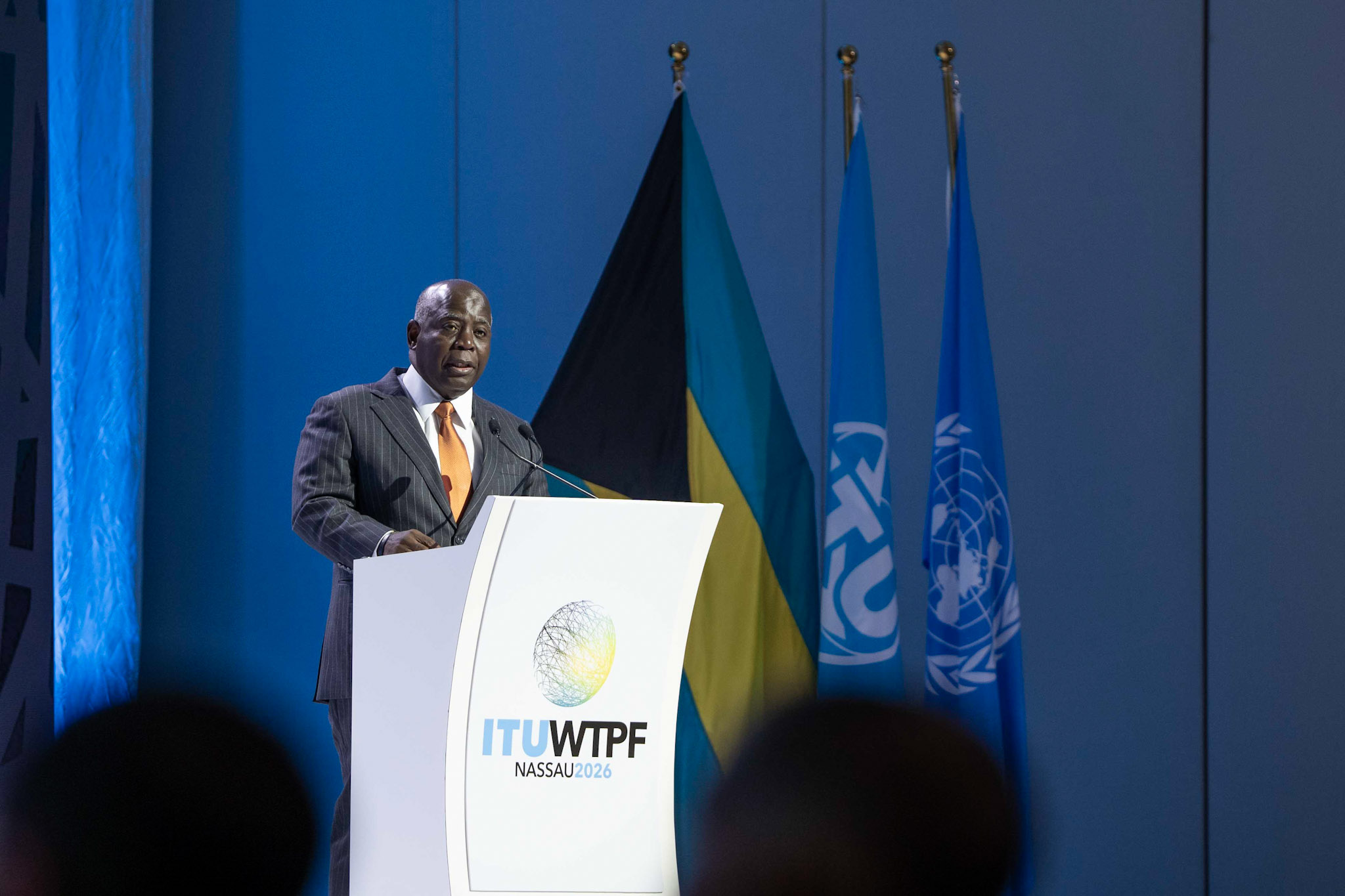
Addressing the World Telecommunication/Information and Communication Technology Policy Forum (WTPF-26) in Nassau, Prime Minister Davis challenged the conventional framing of the “digital divide”, arguing that for many small and developing states, the central issue is no longer simply access to technology, but the terms on which they participate in the digital economy.
“Our people are on the platforms. Our data is in the models. Our waters carry the cables,” Davis said. “Our problem is the terms.”
The Prime Minister introduced what he called the “sovereignty discount” — the hidden economic and strategic cost paid by countries when they enter negotiations without sufficient alternatives, influence or representation.
That disadvantage, he said, can be reflected in the cost of connectivity, restoration times following telecommunications failures, contracts negotiated on take-it-or-leave-it terms, and international technical standards developed without meaningful participation from smaller states.
“A country can be counted as connected and still be paying (the sovereignty discount) every day,” Davis said. “Coverage tells you the signal arrived. It does not tell you who set the price.”
The Prime Minister argued that the rapid expansion of data-driven economies, cloud services, submarine cable networks and satellite connectivity has made digital policy increasingly inseparable from questions of national sovereignty, economic participation and resilience.
He stressed, however, that The Bahamas is not advocating protectionism, technological isolation or barriers to investment.
“We are not hostile to investment. We are open, and we intend to stay open,” Davis said.
Rather, he argued that clear laws, effective regulation and interoperability can strengthen investment by creating greater certainty for both governments and the private sector.
“Capital is not frightened by rules. Capital is frightened by uncertainty,” he said.
Five points. One position. Nassau to Doha.
Prime Minister Davis called on Small Island Developing States to use the Nassau forum to begin developing a common negotiating position ahead of the ITU Plenipotentiary Conference in Doha in November.
He proposed a five-point agenda centred on Data, Control, Resilience, Space and Capability.
On Data, Davis called for personal data to be treated as a protected national interest and for cross-border data arrangements to ensure that countries capture greater local value through skills, processing, investment and revenue.
On Control, he argued that states do not necessarily need to own digital infrastructure in order to govern it effectively, but require enforceable landing rights, meaningful licence conditions, open-access obligations and regulators capable of holding multinational operators accountable.
On Resilience, he called for telecommunications to be treated as critical national infrastructure, including stronger redundancy and restoration requirements appropriate to island states vulnerable to natural disasters.
He pointed to Tonga, which lost international connectivity for weeks after a volcanic eruption severed its sole submarine cable in 2022, as an example of the consequences of inadequate redundancy.
“Volcanoes are not policy. Redundancy is policy,” Davis said.
On Space, the Prime Minister welcomed the opportunities presented by satellite and non-terrestrial networks, particularly for geographically dispersed island states, while warning against allowing critical national connectivity to become overly dependent on individual providers beyond domestic accountability.
And on Capability, he proposed greater shared technical capacity among SIDS so that smaller countries can participate effectively in the international bodies and working groups where global digital standards are developed.
“Five points. One position. Nassau to Doha,” Davis told delegates.
If agreement on all five areas cannot be reached during the Forum, Davis called for the establishment of a formal SIDS caucus or similar mechanism, with a chair, secretariat and reporting deadline ahead of the November conference.
“We are not a small constituency. We are a small population with an enormous jurisdiction,” Davis said, pointing to the extensive maritime jurisdictions governed by SIDS and their role in licensing submarine cable landings, satellite access and spectrum use.
“It is long past time we negotiated like it.”
Connectivity as critical infrastructure
Drawing on The Bahamas’ experience with Hurricane Dorian, the Prime Minister also placed telecommunications resilience within the broader context of disaster preparedness and national security.
Seven years after the Category 5 hurricane devastated Abaco and Grand Bahama, Davis recalled that in the immediate aftermath, what many survivors urgently needed was simply the ability to communicate.
“Not a platform. Not a device. A signal,” he said.
The experience, he argued, demonstrates why reliable communications infrastructure is particularly critical for island and disaster-vulnerable states.
The Prime Minister used the historic Elbow Reef Lighthouse in Hope Town, Abaco, as a metaphor for the wider challenge facing small states. Built during the colonial era to protect international shipping, the lighthouse later passed into Bahamian hands following independence and remains maintained locally today.
The lesson, Davis said, is not to resist technology, but to ensure that the countries affected by it have a meaningful role in determining how it is governed.
“We are not asking anyone to dim the light,” he said. “We are asking for the keys.”
The Bahamas seeks support for Stephen Bereaux
Prime Minister Davis also used his address to seek international support for Bahamian Stephen Bereaux, The Bahamas’ candidate for Deputy Secretary-General of the International Telecommunication Union.
Bereaux previously led The Bahamas’ telecommunications regulator and has more than two decades of experience in the sector and within international telecommunications institutions.
Davis noted that no Small Island Developing State has previously held the office of ITU Deputy Secretary-General, linking Bereaux’s candidacy to his broader call for greater SIDS representation in the institutions where global digital policy is shaped.
“We are not asking to be protected. We are not asking to be prioritised,” Davis said. “We are asking to be present when the terms are set.”
He closed with a declaration intended to define the SIDS position going into the next stage of global telecommunications negotiations:
“We will not be priced by our size. We will not be governed by our absence. And we will not accept a discount on our sovereignty.”