

At Diplomatic Week 2026, Prime Minister positions The Bahamas as a strategic partner for investment, trade and sustainable development through the blue, green and orange economies.
NASSAU, The Bahamas — Prime Minister Philip Davis has called on the international community to reaffirm its commitment to a rules-based international order, strengthen cooperation with small island developing states, and pursue new partnerships in trade, investment and sustainable development.
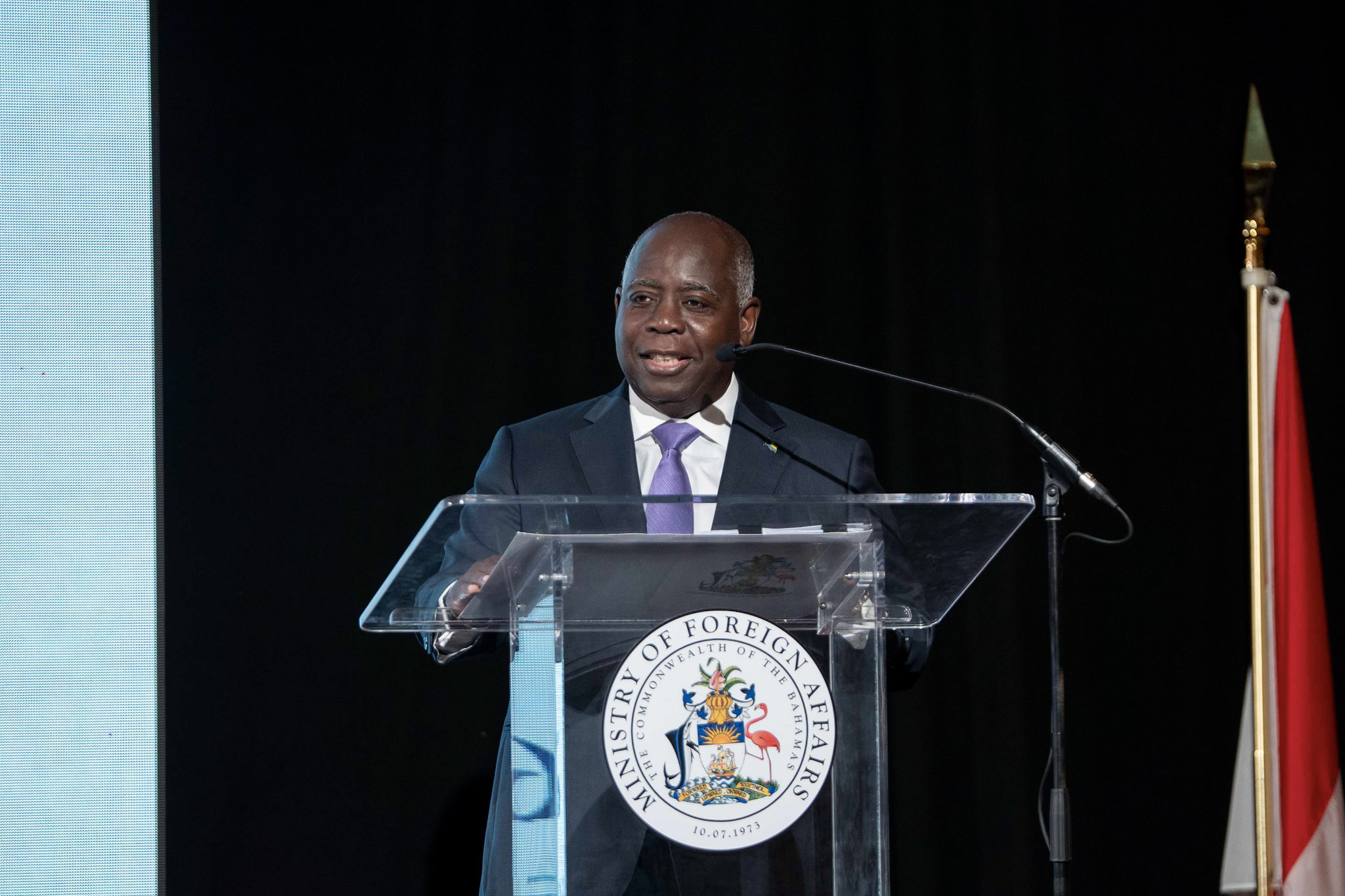
Delivering the keynote address at the opening of Diplomatic Week 2026, Prime Minister Davis outlined The Bahamas’ foreign policy priorities against a backdrop of rising geopolitical tensions, shifting trade relationships and increasing pressures on international institutions.
Under the theme “Orange, Blue and Green Economies: New Frontiers for Trade and Economic Development,” the Prime Minister presented a vision for international cooperation that connects the protection of small states with new opportunities for economic growth, climate resilience and shared prosperity.
He warned that the weakening of international rules and institutions poses particular risks for smaller nations, which depend on multilateral cooperation to safeguard their sovereignty, economic interests and security.
“For small states, the effects arrive early, and they arrive hard,” Prime Minister Davis said, pointing to international financial restrictions, the withdrawal of correspondent banking relationships and mounting pressures on global trade and development commitments.
Reflecting on The Bahamas’ entry into the United Nations following independence in 1973, the Prime Minister recalled the country’s founding commitment to international law and multilateralism.
“That was a bet. A small country with no army bet its future on a simple idea: that rules would protect the weak as well as the strong,” he said.
Prime Minister Davis invoked the legacy of the country’s first Prime Minister, Sir Lynden Pindling, whose inaugural address to the United Nations General Assembly emphasized the equal dignity and aspirations of all nations, regardless of size.
He said those principles remain central to The Bahamas’ approach to international relations, particularly as the global community confronts challenges that no country can resolve independently.
The Prime Minister identified security, economic opportunity, meaningful representation in international decision-making and climate justice among the principal aspirations of The Bahamas and other small island developing states.
He stressed that international financial systems must better recognize the vulnerabilities of countries exposed to severe climate events, even where national income classifications suggest relative prosperity.
“A country can look wealthy on paper and still lose a quarter of its economy to a single storm. Finance on fair terms has to reflect vulnerability as well as income,” he said.
Citing Hurricane Dorian, which devastated Abaco and Grand Bahama in 2019 and caused damage and losses estimated at approximately one-quarter of the country’s economic output, Prime Minister Davis underscored the existential implications of climate change for island nations.
“When we speak about climate, we are speaking about whether our children will inherit a homeland,” he said.
Beyond the challenges confronting small states, Prime Minister Davis issued a direct invitation to international governments, investors, universities and development partners to pursue opportunities in three emerging economic frontiers.
He identified the blue economy as a major opportunity for marine research, ocean conservation, shipping, logistics and transshipment. With an extensive maritime territory, strategically located shipping routes and valuable marine ecosystems, The Bahamas is positioned to deepen its role in ocean-based economic activity and scientific cooperation.
The Prime Minister encouraged international universities and research institutions to collaborate with Bahamian scientists on the country’s seagrass meadows, coral ecosystems and other marine resources.
In the green economy, he highlighted opportunities for investment in sustainable agriculture, agro-processing and clean energy, emphasizing the importance of reducing dependence on imported food and strengthening national resilience.
“For an island, food security is national security,” Prime Minister Davis said.
He also identified the orange economy, encompassing culture and the creative industries, as an important frontier for international trade and investment.
The Bahamas’ music, art, Junkanoo, culinary traditions and creative enterprises, he said, offer significant opportunities for partnerships that can expand market access and strengthen the country’s cultural presence internationally.
“Orange, blue and green. Culture, ocean and land. Each frontier takes something that makes us distinct and turns it into trade the world values,” the Prime Minister said.
He emphasized that these sectors offer opportunities for long-term partnerships that can generate investment, employment and greater economic participation for Bahamians.
The Prime Minister also called for stronger diplomatic coalitions among small states, highlighting the role of international law in advancing climate justice.
He referenced the International Court of Justice’s July 2025 advisory opinion on states’ obligations to protect the climate system, following an initiative led by Vanuatu, as an example of how smaller nations can influence global outcomes through collective action.
Against this backdrop, Prime Minister Davis reaffirmed The Bahamas’ candidacy for a non-permanent seat on the United Nations Security Council for the 2032–2033 term, positioning the bid as an extension of the country’s longstanding commitment to multilateralism and international cooperation.
“That is why The Bahamas is seeking a seat on the United Nations Security Council for 2032 and 2033. When the table is under strain, the world needs more people who believe in it. Help us take our seat,” he said.
The Prime Minister pledged that The Bahamas would continue to honour its international obligations, uphold the rule of law and maintain the institutional standards it advocates internationally.
Addressing the United States, he reaffirmed the importance of the bilateral relationship, citing trade, tourism and maritime security as areas of shared interest.
He also urged major powers to recognize that the international rules and institutions supporting smaller nations contribute to global stability and serve the interests of larger countries as well.
Turning directly to investors and business leaders attending Diplomatic Week, Prime Minister Davis emphasized the country’s stability, commitment to the rule of law and readiness to welcome international partnerships.
“And to the investors and business leaders here this week: the orange, blue and green frontiers are open. The Bahamas is stable and governed by the rule of law. In a world like this one, that may be the most valuable offer on the table,” he said.
Concluding his address, the Prime Minister urged diplomats, governments, investors and international partners to translate shared ambitions into practical cooperation.
“The frontiers are mapped. Orange, blue and green. The partners are here. What remains is the choice to act,” he said.
Reaffirming The Bahamas’ commitment to working with the international community, he closed with a reminder of the principle that has guided Bahamian diplomacy since independence:
“No man, no nation is an island unto itself. A nation of islands may be best placed to remind the world of that.”