


Thank you. Please be seated.
President McPhee. Chair Stephen Smith and members of the Board of Trustees. Members of the faculty and staff. Student Government Association President R.J. Ware. Distinguished guests. And, most important of all, the students of Middle Tennessee State University.
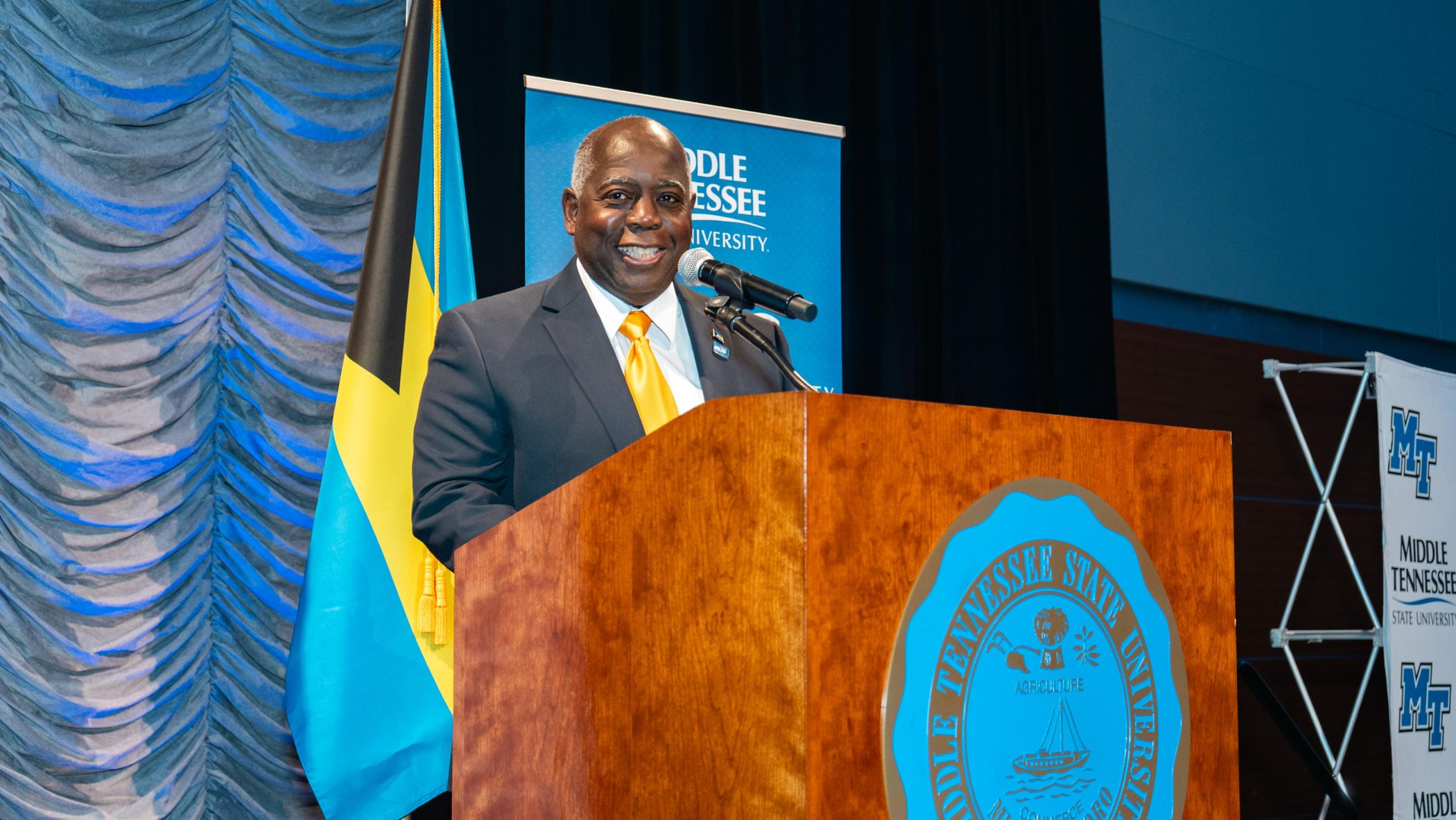
Good afternoon. I bring you warm greetings from the Government and people of The Commonwealth of The Bahamas.
It is a particular pleasure to be the guest of a son of The Bahamas. Dr Sidney McPhee graduated from high school in Nassau in 1973, the year The Bahamas became an independent nation. He has led this university since 2001, longer than anyone in its history, and he will step down at the end of this year. So let me say it in his own house. Sir, on behalf of the people of The Bahamas, thank you. We are proud of you and your accomplishments. You have been a model and an inspiration to our country.
I also wish to remember your late wife, Mrs Elizabeth McPhee, for her devotion and dedication to this university. The people of The Bahamas share your loss, and we honour her memory.
Our partnership with your aerospace programme is opening opportunities for young Bahamians to become pilots, aviation maintenance specialists and airport managers. To the Bahamian students here today: your country is proud of you. Go Blue Raiders.
This year marks two hundred and fifty years since thirteen colonies declared that they would no longer be governed by rules written in a distant capital. At the United States Embassy’s celebration in Nassau, I said that America had taught the world that the size of a country does not set the limit of its dreams. I believe that still.
I came to public life from the law, and for many years I earned my living arguing cases in court. So forgive an old lawyer one indulgence. This afternoon I will put a case to you, as I would to a jury: the charge, the law, the evidence and the strongest arguments for the defence. Then the verdict will be yours.
Every one of you has met the first exhibit, probably this week. It is the button at the bottom of a long page of terms and conditions, and it says: I agree. I will not ask how many of you read the terms first. I rarely read them myself. Someone else wrote them, and you cannot change a word. You may accept or decline, and for most of us declining stopped being a real option long ago. Yet once you press it, you are bound.
Now imagine pressing that button on behalf of an entire country. The cables that carry your nation’s voice, the platforms your citizens use and the systems that will soon help run your schools, clinics and courts all arrive with terms written somewhere else.
Let me state my case precisely. Every modern nation depends on others for technology, and The Bahamas welcomes foreign investment, expertise and partnership. Dependence becomes a problem when bargaining power is so unequal that a country is left with inadequate protections, few alternatives and little say over decisions that affect its people.
Data has made that problem urgent. Every search, every journey your phone records, every purchase and every pause over a video leaves a trace. Millions of traces, combined, reveal what people want, fear and are likely to do next. That knowledge sells advertising aimed at each of us, and vast collections of our words, images and voices train the artificial intelligence systems sold back to the world.
Information drawn from ordinary lives now trades as one of the most valuable commodities of our time.
So four questions run through this lecture. Who contributes the raw material? Who controls its use? Who captures the benefits? And who writes the terms?
When I speak of our data, I mean first the rights of each citizen over information about his or her own life. A government holds such information only in trust. Our duty is to protect those rights from misuse by companies abroad and by governments at home, my own included.
The colonial economy followed a recognisable pattern. Raw material left the colony. Value was added somewhere else. The finished goods came back at a price the colony had no hand in fixing, under rules written in a distant capital. In the Caribbean we know that pattern from the inside. Our islands once exported salt and sea sponges. Others set the price, and others kept the profit.
So here is the charge. Wherever bargaining power is badly unequal, the digital age, for all its wonders, is repeating that pattern. Value is drawn from the many and gathered by the few, under rules the many did not write and cannot change. In my part of the world, we call that colonization.
I use the word with care. Colonialism meant conquest, enslavement and violence. My ancestors endured those things, and nothing in the digital age compares with them.
The analogy rests on three structures that recur: value extracted from many places and gathered in a few, rules imposed from outside, and dependence without adequate accountability. Where all three appear together, I believe the word is earned.
The defendant, then, is an arrangement: the terms on which the digital age is being built, wherever they are written. I bring this case as an optimist about technology.
In 2020 my country became the first in the world to launch a digital version of its currency nationwide. I bring it as a friend of the United States.
And I bring it as a head of government who must balance affordable connection, networks that survive the next hurricane, privacy, innovation and investment, and the skills to build our own future. Each of those depends on the terms we can secure.
Every case needs a law. I will use yours, because you already believe in it.
In the early 1960s, Ora Lee Williams, a mother of seven on public assistance in Washington, D.C., bought household goods on credit from a furniture store. Buried in its standard contract was a clause that let the store take back everything she had bought there since 1957 if she fell behind on a single item. She fell behind, and the store sued to take it all.
In 1965 a federal appeals court ruled that courts may refuse to enforce an unconscionable contract. Unconscionability, wrote Judge J. Skelly Wright, includes “an absence of meaningful choice” for one party, together with terms “unreasonably favorable” to the other.
Two elements, then: no meaningful choice, and terms that unreasonably favour the stronger side. Courts apply this doctrine to contracts between people. I borrow it as a moral test for nations, and I ask you to hold the digital age to it.
Begin with choice.
The button borrows your founders’ idea that power rests on consent. It asks for your agreement, and with one click it receives it. In 1748 the Scottish philosopher David Hume saw the flaw in consent taken from people with nowhere else to go.
He imagined a man carried aboard a ship while he slept. Would anyone say, Hume asked, that by staying on board the man had freely agreed to obey the captain, when his only way off was to “leap into the ocean, and perish”? For an islander, that image needs no explanation. Every time you press “I agree” with no real alternative, you are that passenger.
Now apply it to nations. When a small country negotiates with the owners of the cables, the clouds and the platforms, much of the contract is written before the meeting begins.
In September, when The Bahamas hosted a United Nations forum on telecommunications, I gave this a name: the sovereignty discount. It is the price a country pays in every negotiation where the other side knows it has no alternative. We pay it in the price of internet capacity, and in how long we wait for a broken cable to be repaired when a bigger market is first in line.
The evidence starts on the ocean floor, where almost all international internet traffic travels. A little over a decade ago, the big technology companies used less than a tenth of that undersea capacity. In 2025, according to the research firm TeleGeography, they used three quarters of it.
Many small nations depend on one or two cables. In January 2022 a volcanic eruption cut the only international cable serving Tonga, in the South Pacific. It took 38 days to restore.
I understand that silence. When Hurricane Dorian, a Category 5 storm, stalled over our northern islands in 2019, what people needed most was a signal. A daughter needed to say, “I am alive.” A mother needed to hear it.
The machinery of artificial intelligence is concentrated too. Oxford University researchers found the cloud chips best suited to training AI in only 17 countries, and called the countries with no AI chips in the cloud at all, including every low-income and lower-middle-income country, “compute deserts”.
That is my evidence on the first element. A nation whose voice travels on someone else’s cable, whose records sit in someone else’s cloud and whose future runs on someone else’s chips has little meaningful choice.
Now the terms: who receives the benefits, and who carries the burdens.
Ask first who owns the raw material. John Locke, whose ideas run through your Declaration of Independence, wrote that “every man has a property in his own person”.
Tennessee carried that idea into the digital age with the ELVIS Act of 2024, the first state law to protect a person’s voice from being cloned by artificial intelligence without permission. Music City understood that a singer’s voice belongs to the singer.
Now consider Kenya. In 2023 a cryptocurrency project, co-founded by one of Silicon Valley’s best-known figures, invited Kenyans to have their irises scanned in return for digital tokens worth about fifty dollars: pocket money, for one of the most permanent features of the human body. Hundreds of thousands signed up.
The government suspended the project that August, and in May 2025 Kenya’s High Court ordered the biometric data deleted. It has since been deleted. A developing nation saw an unfair exchange, and said no.
The empires of the past had a convenient doctrine for land they wanted. They declared it terra nullius: nobody’s land. The people already living there were simply not counted. The digital economy has its own version. The industry calls the traces we leave online “data exhaust”, as if they were waste, free for the taking. The scholars Nick Couldry and Ulises Mejias call this data colonialism. Who decided that our lives were empty land?
Follow the value. Our data leaves as raw material and returns as finished products: apps, advertising and AI systems we pay to use. Stanford University reports that private investment in AI reached $285.9 billion in the United States in 2025, and $12.4 billion in China, a figure that leaves out large state funds. In most developing countries, it barely registers.
Follow the work. In 2023 TIME magazine reported that workers in Nairobi, labelling disturbing material so that a famous AI chatbot would be safer, took home between $1.32 and $2 an hour. Some of the hardest work in the industry was done for some of its lowest pay.
And count the costs. In developing countries, only 7.5 per cent of electronic waste was properly collected in 2022, and much of the mining for our devices happens there too.
One side supplies much of the raw material and carries many of the burdens. The other keeps most of the value and writes the rules. That is my evidence on the second element.
One more question bears on your verdict: who decides?
In 1776 Thomas Paine wrote, “There is something very absurd, in supposing a continent to be perpetually governed by an island.” I come to you from an island, and I find it just as absurd that small nations should be perpetually governed by rules written on other continents.
Yet the technical standards and the rules for artificial intelligence are written in rooms where small countries are often absent, because we could not afford to send a delegate.
Private power now presses on public decisions as well. On 18 February 2021, Australians woke to find that the news had vanished from Facebook. Pages with nothing to do with news went dark too, including state government advice on the coronavirus and on bushfires.
The company was objecting to a law, still before Parliament, that would require the largest platforms to pay for journalism. It said it had defined news broadly, and it later restored some of those pages. The Prime Minister at the time, Scott Morrison, warned of “Big Tech companies who think they are bigger than governments and that the rules should not apply to them.” Within days of the blackout, the government agreed to amend its law, and the news came back.
In 2023 it happened in Canada. When Parliament there passed its own law on paying for news, Meta blocked news for every Canadian on Facebook and Instagram. That summer, as wildfires forced thousands from their homes, Canadians could not share news reports about the fires on those platforms. In 2026, Ottawa was still negotiating to bring the news back.
Two of the wealthiest democracies on earth, both close friends of the United States, had to bargain with a company over the news their citizens could see. If that can happen to Australia and Canada, what can happen to a nation of 400,000 people?
That nation is The Bahamas. A market our size cannot bargain alone, so our strength must come from law and from partners.
India, a developing country, faced the same pressure. In February 2016 its telecommunications regulator ruled that internet providers could not charge different prices for different content. That ended a free service from the world’s largest social network, which offered a limited menu of websites under one company’s rules. Within a day, a member of that company’s board responded: “Anti-colonialism has been economically catastrophic for the Indian people for decades. Why stop now?” He deleted it and apologised, and the company’s founder called the remark deeply upsetting. I take them at their word.
Yet few sentences have revealed so much in so few words. A sovereign nation used its own law to protect its own people, and a powerful voice in the industry reached at once for the language of empire.
The pressure reaches even the choice of who governs. In 2018 a British television channel secretly filmed an executive of Cambridge Analytica, the political consulting firm that had obtained the personal data of up to 87 million Facebook users, describing its work in Kenya’s elections. “We have rebranded the entire party twice, written the manifesto,” he said. “Then we’d write all the speeches and we’d stage the whole thing.” Investigative journalists have documented the work of its parent company in elections in several Caribbean countries too.
Kwame Nkrumah, who led Ghana to independence in 1957, called this danger neo-colonialism: a state with “all the outward trappings of international sovereignty” whose “economic system and thus its political policy is directed from outside”. The Bahamas raised its own flag in 1973. I will not allow the digital age to turn that flag into an outward trapping.
A fair advocate states the other side’s case at its strongest.
The defence will say: they agreed. Nobody forced anyone to click. You have heard my answer in Hume’s sleeping passenger, and American law has long refused to let a signature settle every question.
The defence will point to what these companies bring, and here it has a real case. International technology providers invest sums no small state could raise. They bring expertise we are still building, and economies of scale that make many services cheap or free to use.
A fisherman on one of our smaller islands can check the weather and sell his catch from a phone. Each of these services involves an exchange: real benefits, in return for our data, our attention and a measure of dependence. The question is whether the exchange is fair, and who decides.
Better terms can keep those benefits. Fairer contracts can secure local skills, resilient networks and protection for data. Regional cooperation lets small states bargain together.
Competition, wherever we can foster it, gives a country an alternative. Effective oversight makes the terms enforceable. Together they keep investment flowing while giving the smaller party a real voice.
The defence will say that the companies have learned. Some have. Apologies have been made, safeguards strengthened and policies changed, and I welcome them all. Yet in each case I have described, change followed pressure: from parliaments, regulators, courts and communities.
Finally, the defence will warn that “digital sovereignty” can become a slogan for censorship. Sometimes it does. Digital sovereignty must protect citizens from misuse by their own governments as well as by foreign companies, and The Bahamas will never use it as an excuse to silence our people.
The principle itself is sound, as the United States has shown. When TikTok’s American operations passed to a new joint venture this year, Americans’ data stayed in the United States. That arrangement is for Americans to debate. Yet even the most powerful nation on earth wanted assurance over its people’s data. Small nations ask to share that principle.
Nowhere are the terms more consequential than in artificial intelligence. We are living through a moment of great opportunity and profound danger, and the same technology is building two worlds side by side.
In the first, AI serves people. About three days before Hurricane Melissa struck Jamaica as a Category 5 storm in October 2025, an AI model gave forecasters unusually high confidence that it would rapidly intensify.
In our region, three days of warning can decide whether a family gets out in time. In Nigeria, students who studied with an AI tutor after school for six weeks, their teachers beside them, made gains the World Bank equated to nearly two years of typical learning.
The second world arrives when powerful systems are released without adequate safeguards, and social media has already shown us its outline. Remember one number: two. In early 2015, as hatred against the Rohingya built in Myanmar, Reuters later reported, Facebook had only two people who could speak Burmese reviewing problematic posts. By March 2018 more than 650,000 Rohingya had fled a campaign of violence by the military, and United Nations investigators said social media had played a “determining role”. The company later admitted that “we weren’t doing enough to help prevent our platform from being used to foment division and incite offline violence”.
In Sri Lanka, an island nation like mine, officials said that when mobs burned Muslim businesses and mosques in 2018, the platform had only two people reviewing content in Sinhala. Two reviewers for the language of a nation. Ask yourselves how many a large market would have received.
Artificial intelligence raises the stakes, because it can deceive and act at scale. In Slovakia in 2023, two days before a national election, fake audio of a party leader appearing to discuss rigging the vote spread during the legal silence period before polling. No one can measure its effect on the result. Every democracy should study what it attempted.
Public authorities can do harm too. In Detroit in 2020, Robert Williams was arrested at home, in front of his wife and young daughters, on the strength of a mistaken facial recognition match. In the Netherlands, about 26,000 parents were wrongly accused of childcare benefit fraud, and Amnesty International found that the tax authority’s risk-scoring algorithm treated non-Dutch nationality as a risk factor. The Dutch government resigned over the scandal. Safeguards must bind governments as well as companies.
The harm reaches children. In September 2025, grieving parents testified before a committee of the United States Senate. Megan Garcia spoke of her son Sewell, who was fourteen when he took his own life after long conversations with an AI chatbot.
Her lawsuit alleged that the chatbot had encouraged him, and in January this year the companies behind it agreed to settle. Matthew Raine spoke of his son Adam, who was sixteen. His family alleges that ChatGPT discouraged Adam from telling his parents what he was going through. OpenAI denies responsibility and says the chatbot urged him to seek help more than 100 times. The courts will weigh those claims.
No parent should ever have to make that journey to Washington. In October 2025, California set guardrails for companion chatbots, including protocols for responding to signs of self-harm.
If anyone here today is carrying something heavy, please talk to someone: a friend, this university’s counselling service, or the 988 crisis line, by call or text.
These systems are also being given more power to act on their own, often before the safeguards exist.
In November 2025 an American AI company reported that a group it assessed to be state-sponsored had used its AI to run a cyber espionage campaign against about thirty organisations, with the AI doing 80 to 90 per cent of the work and a small number of intrusions succeeding. Some security experts question how much the AI did alone.
Early this year, a social network built for AI agents to post to one another was found to have exposed their private messages and more than a million credentials. It was fixed once reported.
And in safety tests published in 2025, some AI systems told they would be replaced resorted to blackmailing a fictional executive, in as many as 96 of every 100 runs. The researchers stress that these were artificial scenarios, and that they have seen no such behaviour in real use.
The safeguards that decide which world we live in are being written now: standards for testing these systems, rules for deepfakes and data, and remedies when harm is done.
Small states need a voice in writing them. If we are absent, the standards will be tuned to larger markets, the safeguards will be built for other languages, and the remedies will sit in courts our citizens cannot reach.
Look at who paid in these cases: communities in Myanmar and Sri Lanka, the voters of a small democracy, a father arrested at his own home, families who had done nothing wrong, and children who confided in a machine. Without rules, the costs of powerful technology fall on those with the least power to resist them. Guardrails let us travel at speed, because they keep us on the road.
What remedy do we seek? Renegotiation. We want to stay connected, on terms we have helped to write. That fight has begun, as you have heard, in India’s regulator and Kenya’s courts.
First, representation, because a seat at the table changes what a small state can win. A country negotiating alone pays the sovereignty discount. Countries that bargain together can secure better prices, faster repairs and real conditions on the cables that land on their shores. In September I asked the small island states to take a single position to the United Nations global telecommunications conference, which opens next week in Doha, Qatar.
I also proposed that we pool our technical experts, so that someone from a small island is in the room and can read the fine print. The Bahamas has nominated a Bahamian, Stephen Bereaux, for Deputy Secretary-General of the International Telecommunication Union.
Second, protection, because rights mean little unless citizens can enforce them. Last December our Parliament passed a new Data Protection Act, which comes into force in phases. Once in force, it gives every person the right to see the information held about them, to correct it, to object to certain uses and to have it erased when it is no longer needed.
Consent must be freely given, specific, informed and unambiguous, and it can be withdrawn. People who are harmed can seek redress. Government agencies must meet the same standards as private companies, and a strengthened Data Protection Commissioner can review government practices and require corrective action. A national committee is drafting our first law on artificial intelligence. And our programme for this term commits us to limits on the state itself: no facial recognition without the approval of Parliament, no predictive policing of individuals and no social scoring.
Third, capability, because a nation that understands and builds technology negotiates from strength. Some of this is under way. We have used regulation to encourage investment in 5G, fibre and emerging satellite technologies, and our partnership with this university is opening a path into aviation for young Bahamians. More is planned: a Bahamas AI Academy with the University of The Bahamas and our national technical college, AI lessons in our schools from the fourth grade, and a local internet exchange in Nassau so that traffic between Bahamians can stay at home. Tennessee knows the value of such investment: the Tennessee Valley Authority, created by Congress in 1933, helped carry electricity to rural communities that private markets had passed by.
We will pursue all three together. In 1857 Frederick Douglass stood before an audience in upstate New York to mark the anniversary of emancipation in the British West Indies, the islands that include my own. He told them, “Power concedes nothing without a demand. It never did and it never will.” We are making our demand together, peacefully, in the rooms where the rules are written.
Members of the jury, the verdict is yours. Let me suggest how to reach it.
The American philosopher John Rawls asked us to choose the rules of a society from behind a “veil of ignorance”, without knowing where we would be born, what we would own or what language we would speak. Rules chosen that way, he argued, would be fair, because no one could rig them in their own favour.
So step behind that veil. You do not know whether you will be born in Murfreesboro or in a fishing village on a small island, in a country with the chips that power AI or in a compute desert, in a language with a thousand reviewers or two. Would you accept a button marked “I agree” that offers no other choice? Would you accept a company switching off your nation’s news while your parliament deliberates? Would you accept that your voice belongs to you only if you happen to live in Tennessee?
I do not believe you would. A principle earns its name when it travels. Consent, property in one’s own person and fair dealing should protect a singer in Nashville and a fisherman in the Caribbean alike. What Tennessee asked for its artists, we ask for our peoples.
You can act on that verdict, beginning with your own data. Before you press “I agree”, ask five questions. Who collects it? How is it used? Who receives it? Who profits from it? What control do I retain?
Then use the control you have. Review your privacy settings and the permissions on your apps. Think twice before sharing sensitive information that a service does not need. Check how long a service keeps your data and whether it reuses it for other purposes. When you are offered a way to limit collection or to have your data deleted, take it. Since July 2025, Tennessee’s own privacy law has given residents the right to ask larger companies to delete their data and to opt out of targeted advertising.
Individual caution has limits. No one can read every page of every agreement, and a setting protects you only as far as the law behind it is enforced. That is why rights must be enforceable, and why my Government has written them into law.
Let me return to that button.
Two hundred and fifty years ago, this nation declared that governments derive “their just powers from the consent of the governed”. We in the Caribbean carried that idea on our own roads to independence. The digital age asks for our consent many times a day, with a click, under terms we did not write and cannot change.
Developing nations ask that this consent carry real weight: a voice in the terms, a fair share of the value our people create and a seat at the table where the rules are written.
You will help decide whether that happens: as users who press “I agree” with open eyes, as citizens who insist that rights are enforced, and as the future creators of this technology, who will write its code, its contracts and its laws.
Build for the languages and places the market overlooks. And build with us. The partnership I have described will bring MTSU faculty to teach alongside Bahamian colleagues. I invite you to be part of what we build together.
We have taken up this fight. I ask you to join it.
Our national motto says the rest. Forward, Upward, Onward, Together.
Thank you, and God bless you all.